The true value of hospitality is forged in the daily details of those who work with time on their side.
Or why the future of hospitality is no longer just about taking care of the guest, but about first taking care of those who make their rest possible.
By Ehab Soltan
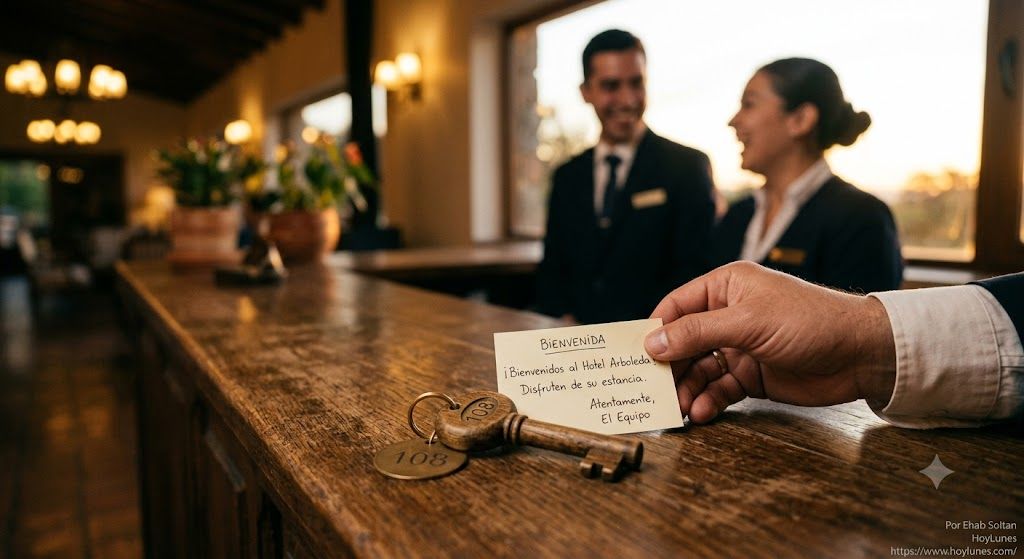
HoyLunes – The lobby is a temple of sensory stimulation. Crossing the revolving door after a ten-hour transatlantic flight, the traveler is greeted by a perfect choreography: a subtle fragrance of cedarwood and fig floats in the air, indirect lighting mimics the warmth of sunset, and a stream of soft jazz dampens the echo of suitcases on the polished floor. Everything seems designed to convey well-being.
The traveler approaches the reception desk. On the other side, an impeccably uniformed professional welcomes him. She smiles. It is a practiced, symmetrical, and formal smile. Yet, in the slight tremor of her eyelids, the stiffness of her shoulders, and the millisecond it takes her to process the reservation name, the guest senses something invisible yet impossible to hide. The screen she looks at does not just reflect the data from the booking system; it reflects the fatigue of an endless workday.
At that precise moment, the illusion of luxury cracks. The traveler understands, perhaps unconsciously, an uncomfortable truth: well-being in a hotel never begins with the decor. It begins with the people. No hotel can offer a peace that does not first exist among those who sustain it.
No hotel can offer a peace that does not first exist among those who sustain it.
The Greatest Invisible Investment
For the last half-century, the hotel industry has operated under a formula of tangible investment. Billions of euros have been poured into over-designing rooms, importing Carrara marble, building infinity pools, and upgrading automation systems. Success was measured in square meters and the spectacular nature of physical assets.
However, the true competitive advantage is migrating from the material to the intangible: the emotional energy of the team. Caring for the balance of those who work in it is no longer raised as a mere public relations exercise or an ethical guideline. Today, it is the most critical strategic asset of the business.
This transformation does not occur in a vacuum; four historical forces converge at this moment, forcing a paradigm shift. First, the shortage of talent and the difficulty of retaining professionals in the hospitality sector. Second, the increase in exhaustion and burnout following the crises of recent years. Added to this is a traveler profile that values authenticity over mechanized service and, finally, the emergence of artificial intelligence, which, by automating operational tasks, makes the differentiating value more human than ever.
The Guest Does Not Buy a Room
When a traveler makes a booking and pays a nightly rate, they believe they are buying physical inventory: a bed with sheets of a certain thread count, a high-pressure shower, a breakfast, or a privileged view. But that is only the transactional layer of the journey.
What the customer is actually looking for and buying is something far more complex to manufacture. They seek to feel safe—because the human brain evaluates an environment before enjoying it—heard, calm, welcome, and understood. They want the space to act as a balm against external chaos. And none of those feelings can be bolted to the wall or programmed into software. They depend strictly on the emotional state of the staff attending to them. Real hospitality is an exchange of energy; if the sender is drained, the receiver will only perceive interference.
The Worker Also Lives the Hotel
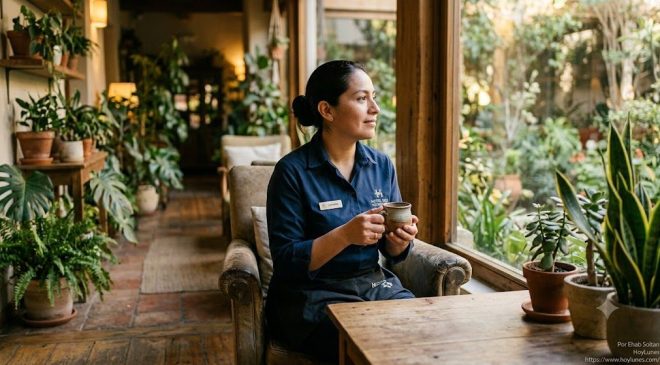
Behind every great hotel experience, there is an invisible creator. The hotel employee is not a mere service operator; they are the true architect of the customer experience. Their workday begins long before the first guest wakes up and extends long after the lights at the rooftop bar go out.
Sustaining the operation of an establishment involves making thousands of invisible micro-decisions every hour: anticipating a table’s food allergy, calibrating the tone of voice to calm an unsatisfied customer, or coordinating for a room to be ready five minutes ahead of schedule. Each of these gestures drastically alters the traveler’s perception of the destination. The employee is the conductor of a silent orchestra, and their primary instrument is their own emotional stability.
The Most Expensive Smile in a Hotel
There is an element in hospitality that possesses invaluable worth but zero production cost: the authentic smile. We are not referring to the corporate, standardized grimace demanded in welcome manuals, but to the spontaneous gesture born of real empathy.
That gesture cannot be installed like a bathroom accessory, it cannot be bought in bulk, it cannot be designed by a star architect, and artificial intelligence is incapable of replicating it with truth. It only flourishes when a healthy work ecosystem exists. This forces us to ask the big question that makes the sector uncomfortable:
Can an organization sell rest to the outside world while producing exhaustion on the inside?
No brand can convey serenity for years if those who represent it live in a state of burnout.
Architecture for People, Not Just for Customers
When a property decides to undertake a comprehensive renovation, the focus is usually placed on public areas and luxury suites. Elevators are replaced, exteriors are landscaped, and restaurant furniture is renewed. But what happens to the areas the guest never sees?
A true renovation with a vision for the future must be holistic. Redesigning a hotel means rethinking the routes of the housekeeping staff with ergonomic criteria to prevent injuries, improving lighting and thermal comfort in internal corridors, designing staff dining rooms that function as genuine spaces for relaxation and recovery, and acoustically isolating work areas. A hotel also communicates its values in the spaces where a customer never enters. This invisible renovation, focused on the well-being of the workforce, is quiet, but in the long run, it is the one that offers the greatest return on investment.
Hospitality as an Ecosystem
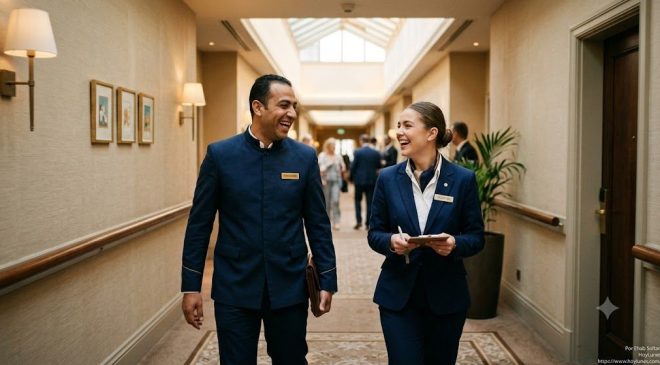
Well-being is not a static product delivered on a tray; it is a flow of energy circulating through a living system. Well-being travels from management to the teams; from the teams to the guest; from the guest to the destination; and, ultimately, to the hotel’s reputation and profitability.
When a hotel’s management prioritizes empathy, flexibility, and respect for the rest periods of its middle management, that attitude naturally filters down to the front-line teams. A supported and serene employee cares for the guest with genuine warmth. The guest, experiencing that truth, raises their assessment of the hotel and the destination, which translates immediately into direct digital reputation and, ultimately, into solid financial profitability. If the first link in the chain breaks due to excessive pressure, the entire system loses its authenticity.
The New Luxury
There was a time when luxury was defined by physical opulence: the accumulation of gold-plated fixtures, imported marbles, and signature menus. Later, the concept evolved toward the pursuit of extreme exclusivity and absolute privacy.
Today, in a hyper-connected world saturated with stimuli, true luxury has changed its nature. The greatest contemporary privilege when traveling is to enter a space where the entire human team transmits a natural and organic calm. Serenity is also a form of luxury. It does not happen because an operations manual forces them to modulate their voice, but because they work in an environment designed to protect their inner peace. The serenity of the staff is the new standard of high-end hospitality.
What Unnatural Intelligence Can Never Manufacture
Automation and artificial intelligence are redefining the operational processes of hospitality at a rapid pace. Machines can already process check-ins in seconds, translate requests into dozens of languages in real-time, optimize rates predictively, and recommend personalized activities with mathematical precision.
However, the core of hospitality remains deeply human. A machine may be efficient, but it will never be able to offer compassion when a traveler arrives disoriented, nor will it transmit that contagious serenity that calms the stress of a day of meetings, nor will it possess the empathy needed to detect that a quiet guest needs an extra gesture of care. The differential value of the hotels of the future will lie, unequivocally, in our ability to connect through authenticity and presence.

The Profitability of Well-being
Addressing the well-being of teams is not an exercise in philanthropy or a well-intentioned declaration of intent; it is a pragmatic and smart business decision. In an industry where replacing an experienced employee can cost thousands of euros in recruitment, training, and lost productivity, caring for people stops being an ethical question and becomes a first-rate economic decision.
A work environment that places the employee at the center achieves:
- Drastically reducing staff turnover, protecting the company’s accumulated know-how.
- Improving productivity and proactivity, decreasing absenteeism due to professional burnout.
- Retaining high-value clients, who return to an establishment to reconnect with the people who truly care for them.
- Strengthening brand reputation in a market where travelers actively penalize poor labor practices.
The Traveler Also Has a Responsibility
For this ecosystem to function sustainably, we cannot isolate the final consumer from the equation. As travelers, we have become accustomed to demanding absolute availability, instant immediacy, and seamless perfection in every service interaction, frequently forgetting the humanity of the person attending to us.
The guest is not a passive observer; their attitude, respect, and empathy toward housekeeping staff, waiters, and receptionists directly determine the emotional atmosphere of the hotel. True hospitality is two-way. Understanding that behind every desk and every service door there is a person with their own limits and needs is the first step toward becoming mature travelers. Perhaps the next revolution in tourism is not about traveling further, but about learning to relate better to those who make the journey possible.
The Hotel of the Future Will Not Be Remembered for Its Pool
Twenty or thirty years from now, the material details of the trip will have faded from the guests’ memories. No one will remember precisely the size of the TV in the room, the design of the outdoor pool, or the brand of the climate control system.
What will remain intact in the memory is how they made us feel at a given moment. That feeling of warmth and belonging that transforms an unfamiliar building into a temporary refuge never grows out of noble materials, cutting-edge technology, or avant-garde interior design. It arises, solely and exclusively, from the quality of life, dignity, and balance of the people who opened the door for us when we arrived. Because no hotel can offer peace to its guests if it has not first learned to offer it to those who make it possible.